GNS: The Utility Token Powering Gains
Introduction
$GNS is the backbone of Gains, enabling efficient liquidity management, revenue distribution, governance, and long-term sustainability. Designed with flexibility in mind, its tokenomics evolve based on community decisions and market conditions. Over time, $GNS has been net deflationary, reinforcing its role in the ecosystem. Originally launched as $GFARM2 on Ethereum, the token underwent a fair distribution through ETH and LP pools before being migrated to Polygon with a 1:1000 split, rebranding as $GNS. It now operates across multiple chains, supporting Gains’ growth and stability.GNS Utility and Tokenomics
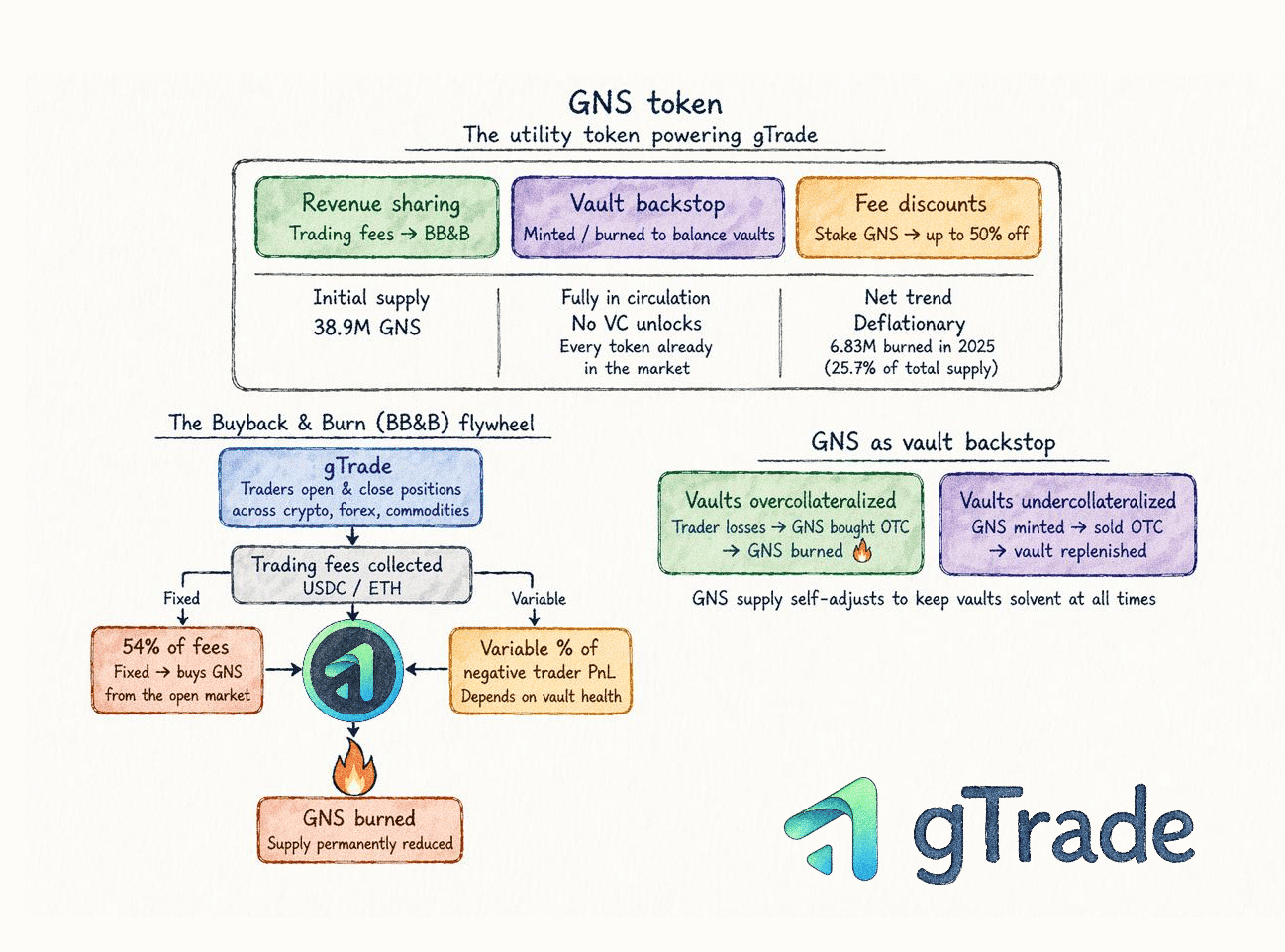
$GNS serves multiple core functions within the Gains ecosystem:- Revenue sharing - Trading fees can be used for buyback and burn (BB&B), with flexibility for direct staking rewards depending on governance decisions.
- Counterparty utility - Acts as a balancing mechanism for vaults, supporting liquidity efficiency and protocol stability.
- Fee discounts - $GNS can be staked for fee discounts in tiers up to 50%. See $GNS Discounts.
How Buyback & Burn (BB&B) Works
When active, BB&B works as follows:- Trading Fees (55%) – The majority of Gains’ revenue (from open and close fees in USDC, DAI, WETH) is used to buy back $GNS from the market, reducing supply.
- Dynamic % of Trader PnL – Depending on the gToken Vaults’ health, a portion of trader losses/profits are used for $GNS buybacks/mints.
GNS Tokenomics: Adaptive & Deflationary
$GNS supply mechanics balance protocol needs with long-term sustainability:- Minting & Burning – Vaults dynamically mint and burn $GNS to manage the protocol’s liquidity.
- Max Supply – Capped at 100,000,000 $GNS as a failsafe mechanism (should never be reached under normal conditions).
- Initial Supply – 38,892,000 $GNS at launch, with continued deflation over time.
How to Get $GNS
$GNS is available on multiple decentralized exchanges (DEXs) and centralized exchanges (CEXs).DEXs
- Arbitrum: Camelot Exchange
- Base: Uniswap
CEXs
We do not guarantee price appreciation or depreciation in the future, nor promise any development of the project compared to its current state, and if you buy the token, you do so at your own risk.